Saturday, November 7, 2009

Accenture Acquires a Phone Concern From Nokia

Accenture, the technology consulting firm, agreed to buy a Nokia business that advises and provides services for cellphone makers using the Symbian operating system, the companies said Friday. The unit helps phone manufacturers make the operating system work with their products, and aids chip makers and carriers. Terms were not disclosed. The deal adds 165 employees to Accenture’s organization and lets the company expand a business that provides consulting services related to mobile operating systems. Symbian is the world’s most popular software running more advanced cellphones, and is used on more than 250 million handsets.
Symbian, managed by the Symbian Foundation of London, competes with Microsoft, Research In Motion and Apple in making software for phones that allow users to access the Web, check e-mail, play music and transmit video clips. The deal is expected to close by the end of the third quarter. 

Accenture to acquire Nokia's Symbian service experts

In a move that will further increase Symbian's independence from Nokia, the Finnish phone manufacturer has agreed to sell its Symbian Professional Services unit to technology consultant firm Accenture.
The unit is responsible for customer engineering and customer support for Symbian OS, the world's largest operating system for smart phones. About 165 people will be transferred to Accenture as a result of the agreement, the terms of which were not disclosed.
The transaction, announced Friday, is expected to close by the end of the third quarter, according to a press release from Nokia.
Nokia acquired Symbian last year and transferred the operating system to the nonprofit Symbian Foundation. The organization on Thursday announced its take on application distribution--the Symbian Horizon application-publishing platform

Nokia Dumps Symbian Services Unit

Is this the beginning of the end for Symbian? On July 17, Nokia announced it will sell its Symbian professional services unit to Accenture. The division provides engineering consulting and product development services to mobile phone manufacturers, chip makers and wireless service providers that develop products based on Symbian software for mobile phones. This software is the most widely used in smartphones today, but it’s been fast losing ground to rivals such as Android.
The sale is yet another indication that “Nokia keeps distancing itself from Symbian, divesting of nearly anything that is directly related,” Jack Gold, principal at J. Gold Associates, wrote in this morning’s note. “This reinforces our earlier position that Symbian is no longer strategic to Nokia’s success.” Considering that Nokia is the world’s No. 1 cell phone maker, that’s bad news for Symbian.
Even though Symbian has been restructuring and making an effort to attract developers in order to stabilize its market share and regain its momentum, that may not be possible now as even its biggest supporter, Nokia, moves on to greener pastures. “I’d expect Nokia to offer ‘other’ [software, such as Android], within the year,” Gold writes. As it makes a push into Mobile Internet Devices, or tablets, Nokia will use alternative software rather than Symbian for those gadgets as well, he says.
Symbian will have “a tactical rather than a strategic potion in Nokia’s future,” Gold writes. And that likely means that Symbian will continue to see its market share melting despite all the changes and innovations it makes to the software.
That said, this is a smart move for Accenture, which likely picked up the unit on the cheap (the amount of the deal has not been disclosed). As handset makers and carriers launch their app stores and keep on innovating on handset software, they will want to outsource more of that work to reduce costs. That’s where Accenture will come in.
The company, which already has expertise in Windows Mobile and Symbian software, plans to leverage the staffers and know-hows it acquires from Nokia to expand into all kinds of mobile software, including Android. “We have a huge ambition in this space, and this is a strategic acquisition,” says Jean-Laurent Poitou, managing director of Accenture’s Electronics & High-Tech industry group.

UPDATE 1-Accenture to buy Symbian services unit from Nokia

* Nokia says deal will help Symbian realise full potential
* No price disclosed for sale of unit with 165 staff
* Acquisition expected to close within 90 days
(Adds details on unit, background, shares)
LONDON, July 17 (Reuters) - Technology consulting firm Accenture (ACN.N) has agreed to buy a unit of Nokia (NOK1V.HE) responsible for servicing the Symbian smartphone operating system that Nokia has given to an open-source foundation.
The parties did not disclose the price on Friday that Accenture would pay for the business, which has about 165 staff who provide customer support and engineering for Symbian, the world's most popular smartphone system.
Nokia decided last year to make Symbian technology freely available in the hope it would encourage Internet developers to build innovative applications on the platform, helping it win back market share.
Peter Rupke, Nokia's head of devices, said in a statement on Friday: "This agreement allows the Symbian professional services team to realise its full potential in the supply of independent services to the open-source ecosystem."
Accenture said the acquisition would expand its ability to help customers in the fast-growing market for converged mobile services, as phones become more and more like computers and computing becomes more mobile.
The transaction is expected to complete within 60-90 days.
Nokia shares, which had been down about 2 percent after the company gave a disappointing outlook on Thursday, recovered slightly to trade down 1.8 percent at 9.30 euros by 1236 GMT. (Reporting by Georgina Prodhan; Additional reporting by Eva Lamppu in Helsinki; Editing by Jon Loades-Carter) 

Nokia profit from phones falls 66%

STOCKHOLM–Nokia Corp., the world's top cellphone maker, said yesterday second-quarter earnings fell 66 per cent as the global recession sapped demand, and its stock sagged after it scrapped its target to gain market share this year.
Net profit was 380 million euros ($601 million Canadian), down from 1.1 billion euros in the same period a year earlier. Sales tumbled 25 per cent to 9.91 billion euros.
Analysts polled by SME Direkt had forecast a profit of 327 million euros and sales of 10.1 billion euros. Nokia shares fell nearly 15 per cent to 9.47 euros in Helsinki, and in New York closed down $2.20 (U.S.), or 14.16 per cent, at $13.46
Nokia shipped 103 million mobile devices in the quarter, down 15 per cent from a year earlier, but better than some analysts had expected. The average selling price of a Nokia handset hit 62 euros from 74 euros.
"It almost feels like Nokia has been doing a great job at keeping shipments alive, but has been forced to cut prices to keep volumes up," said Neil Mawston, a telecom analyst at Strategy Analytics.

Nokia May Lose Smart-Phone Buyers Without Apple-Like Programs

July 17 (Bloomberg) -- Nokia Oyj, the world’s largest mobile-phone company, may be losing smart-phone customers by failing to come up with applications and designs to take on Apple Inc., analysts said.
Nokia plunged the most in more than five years yesterday, shaving 6.1 billion euros ($8.6 billion) off its market value, after lowering targets for market share and profit margins.
“This is a very tough spot for Nokia to be in right now,” Colin Gillis, an analyst at Brigantine Advisors in New York, said in a Bloomberg Radio interview. “They’re going to need the types of devices that people can use to download applications and the kind of devices that people can be interactive with, the types of devices we’re seeing out of Apple.”
Nokia’s share of the smart-phone market was 41 percent in the second quarter, down from 62 percent in 2005. Nokia estimates its overall market share was 38 percent in the period, down from 40 percent a year earlier. The overall share will be little changed this year, compared with a previous forecast of an increase, the Espoo, Finland-based company said yesterday.
Instead of building a single flagship device such as Apple’s iPhone, Nokia has multiple smart-phone lines like the E Series and N Series, as well as music phones. That approach makes it difficult to attract software developers, who prefer to write programs for a single platform with a large user base such as the iPhone than tailor their applications for a variety of handsets, said Broadpoint Amtech Inc.’s Mark McKechnie.
“They do need to figure something out to keep themselves relevant for users,” the San Francisco-based analyst said. “The smart phone is critical to maintain a lead in the overall handheld market.”
Stock Performance
The operating margin in the main devices and services division will be little changed in the second half from the first, when it was 11.3 percent. Nokia earlier predicted the margin would be in the “teens.”
Nokia plunged 1.63 euros, or 15 percent, to 9.47 euros in Helsinki yesterday, the most since April 2004. Before that, the stock was little changed for the year.
Nokia won’t return to its days of 40 percent share of the overall mobile-phone market and 20 percent operating profit margins, said McKechnie, who rates Nokia shares “neutral.”
Nokia anticipates the global handset market will shrink about 10 percent in 2009 because of slumping economies and consumer spending. The market for smart phones, which can run computer-like applications, is the industry’s fastest-growing segment, according to researcher Gartner Inc.
Software Battle
“Competition is increasing in the smart-phone area as many participants rush into one of the few growing markets,” Chief Executive Officer Olli-Pekka Kallasvuo said on a conference call with analysts yesterday.
Those rivals include Palm Inc., which last month started selling its Pre model and opened its App Catalog. Research In Motion Ltd., the maker of the BlackBerrySamsung Electronics Co. have also opened applications stores. smart phones, and
Another dominant software player making inroads in the market is Microsoft Corp., whose Windows Mobile operating system works on Samsung, Sony Ericsson Mobile Communications Ltd. and HTC Corp. phones. Google Inc. is also aiming for a share of the pie with its Android mobile operating system.
Nokia has been under siege before. Its global market share fell to the lowest in five years in 2004 as customers picked clamshell phones made by Motorola Inc., Samsung and Sony Ericsson, a trend Nokia had discounted. Nokia fought back with clamshell models, clawing back market share and reaching 40 percent in 2007.
N97 Debut
The Finnish company began to refresh its smart phones last month with the N97, which combines a touch screen and a snap-out keyboard. The device sold 500,000 units in June, Kallasvuo said on the call yesterday. Cupertino, California-based Apple sold more than 1 million units of its latest model, the iPhone 3G S, in the first three days of its debut last month.
Software downloads also have Nokia management’s attention. Ramping up the online Ovi Store for applications is central to Kallasvuo’s vision of Nokia becoming a software provider that gets revenue from customers continuously, and not just every few years when they buy a new mobile phone.
Creeping Up
Nokia’s share of worldwide smartphone sales fell to 41.2 percent in the first quarter from 45.1 percent a year earlier, according to Gartner, while Apple’s doubled to 10.8 percent. Nokia shipped 103.2 million phones in the quarter, a 15 percent drop from a year earlier, while its smartphone sales increased 10 percent to 16.9 million units.
Second-quarter net income at Nokia fell to 380 million euros from 1.1 billion euros a year earlier, while revenue slid 25 percent to 9.9 billion euros.
“Nokia is way ahead in all regions of the world, except the USA, where it is being battered by Apple and BlackBerry,” said Neil Mawston, a director at researcher Strategy Analytics Ltd. in Milton Keynes, England. “The USA is now the world’s most important smartphone market and Nokia urgently needs to recover in that region if it is to be taken seriously as a mobile consumer services player.”
The company said yesterday it lost overall market share in Latin America, the Asia-Pacific region and North America from a year earlier.
“They need to get a better user interface on their devices, and they need to do that very soon,” said Carolina Milanesi, an Egham, U.K.-based analyst at Gartner. 

Nokia sales and profits dip in 2nd quarter

Nokia, the world's largest maker of mobile phones, reported Thursday that its second-quarter operating profit fell 71 percent to 427 million euros ($600 million) from 1.47 billion euros during the same quarter a year earlier.
The company also reported that sales fell about 25 percent to 9.9 billion euros in the second quarter. But sales were up 7 percent sequentially from the first quarter of 2008.
Nokia shipped 103.2 million units during the quarter, which was down about 15 percent compared with a year earlier. But shipments were up 11 percent sequentially compared with the first quarter of this year.
And the company reiterated its expectation that the entire mobile market would contract about 10 percent during 2009.
That said, CEO Olli-Pekka Kallasvuo said in a statement that the worst may be over.
"Competition remains intense, but demand in the overall mobile device market appears to be bottoming out," he said. "As before, we are continuing to tightly manage our operating expenses."
Nokia said that it increased its market share sequentially for global sales of mobile phones to an estimated 38 percent. And its smartphone market share grew sequentially to 41 percent.
Toward the end of the second quarter, Nokia brought its N97 smartphone to the U.S. market.
The company changed its forecast for the third quarter, and said it expects its third-quarter market share in mobile phones to remain flat sequentially. The company had expected to increase market share in the second half of the year, but now it expects market share to remain flat.

Nokia sees bottom to mobile market malaise

The mobile handset market is set for recovery after the worst economic downturn since the Great Depression, according to Nokia, the world's largest maker of cell phones.
The cell phone market has been hit particularly hard by the worldwide economic slowdown. And companies such as Nokia and Sony Ericsson have taken a beating.
The second quarter of 2009 was particularly hard for Nokia. The company's earnings were ugly with a 25 percent drop in revenue, a 15 percent drop in handset shipments, and a more than 70 percent decline in operating profits, compared to the same quarter in 2008.
Sony Ericsson, which reported its second quarter earnings just hours before Nokia, also had a poor showing in the second quarter. The company posted a 213 million euro ($301.4 million) net loss for the second quarter, which was down from a profit of 6 million euro ($8.5 million) during the same quarter a year ago.
But for Nokia and Sony Ericsson there are glimmers of hope in their results. Sequentially, Nokia's revenue and profits improved slightly compared to the first quarter of this year. And Sony Ericsson posted a narrower net loss than analysts had forecast.
These bits of positive news are likely contributing to a growing sense that the worst of the recession may be over.
"Competition remains intense," said Nokia's CEO Olli-Pekka Kallasvuo. "But demand in the overall mobile device market appears to be bottoming out."
This is good news for an industry that some market research firms have predicted will see at least a 20 percent drop in product shipments for 2009 compared to 2008. Nokia admits that neither its company nor the industry as a whole is out of the woods just yet. It reiterated on Thursday that it expects the industry to shrink about 10 percent in 2009 compared to last year.
But news that Nokia, which sells about 40 percent of all handsets in the world, is seeing the light at the end of the tunnel is a major positive for the industry and the economy as a whole. Even though unemployment rates are still rising in the U.S. and abroad, there are other signs from the technology industry that consumers and businesses are starting to spend again.
Earlier this week, Dell said it's seeing demand for its products--PCs, services, servers--"stabilizing." And Intel released an upbeat outlook during for its second-quarter report on Tuesday. Intel's feel for the market is an important bellwether for the tech industry, and the chipmaker reported its best first-to-second-quarter growth in almost two decades. CEO Paul Otellini declared it a "clear expectation for a seasonally stronger second half."
These are all good signs that the economy is headed for recovery. But the climb back to robust growth could be a slow one. And there's no guarantee that a rising tide will lift all boats, especially in the mobile handset business.
Right now, the mobile handset market is going through a massive transition. Cell phones that were once used simply to make phone calls have evolved into jack-of-all-trade devices. Increasingly, cell phones are being used to provide Internet connectivity that allows people to use new forms of communication, such as social networking sites. Olli-Pekka acknowledged this trend during Nokia's second-quarter conference call with analysts and investors, noting that in the future more people will connect to the Internet via a cell phone than a computer.
"A new industry is emerging as the Internet and communications converge," he said. "And consumers will increasingly demand products that are more integrated."
Nokia has been at the forefront of developing devices that do just that. The company has led the market with its 3G wireless portfolio and it has led the market in terms of worldwide shipments with its smartphone devices, the N-series and E-series phones. On Thursday, it reported that some of these devices have been doing quite well worldwide. For example, it shipped 3.7 million 5800 series handsets during the quarter. And it also noted I has sold a total of 5 million units of its popular E71.
Smartphones are key
Smartphones in general are expected to lead growth in the industry as consumers look for more advanced features and easier access to the Internet and online applications.

But recently Nokia has lagged in terms of innovation here. Meanwhile, Apple is now viewed the leader in terms of innovation with its iconic iPhone. And other companies like as Research In Motion and Palm are also making advances with their own products. The new Google Android operating system, which will be on a whole slew of devices in the second half of 2009 and into 2010, is also expected to push the industry forward in terms of innovation.
Nokia and Sony Ericsson, each recognize that they need new products in the smartphone market to excite consumers. Sony Ericsson's flagship smartphone, Xperia, has so far not been particularly strong. But the company is working on other new products. And during a conference call with investors, Sony Ericsson Chief Executive Dick Komiyama said his company's new product portfolio should contribute to "healthier topline development" once shipments start later in 2009.
"The market is going through a huge seismic shift right now. People want more functionality in their phones, even the less expensive phones. They are demanding a good user interface. And they're refusing to put up with a bad Internet experience."
--Frank Meehan, CEO of INQ Mobile
Nokia's Olli-Pekka also noted that the company plans to increase its focus on developing more advanced phones.
"The line between handsets and PC will not exist in the future," he said. "And our ambition is to become the leading provider for these integrated mobile devices."
But Olli Pekka also emphasized the need to address the low and mid-range of the mobile market as well. And he emphasized the need for Internet connectivity and sophisticated technology in these devices as well.
"As we have said before, one size doesn't fit all," he said. "Nokia will continue to address all price points and all markets globally."
This is exactly the market that INQ Mobile, a new handset maker backed by Hutchison Whampoaa, is addressing. Smartphones may offer more growth, but basic Java-based feature phones still make up the bulk of the market. Today about 40 percent of the cell phone market is made up of phones that operators buy for between $36 and $99, according to Strategy Analytics. These are typically basic feature phones. Smartphones, which sell to carriers for more than $300 a pop, make up about 17.8 percent of the market currently, says Strategy Analytics.
In terms of market share, these figures are not expected to change much over the next few years. Mass market devices, which are in the mid-tier in terms of pricing, will continue to make up about 40 percent of the overall cell phone market well into 2014, the firm has said. But this doesn't mean that the average consumer will settle for me-too low-functioning devices. They are increasingly demanding more advanced functionality in lower-priced devices.
"The market is going through a huge seismic shift right now," said Frank Meehan, CEO of INQ Mobile. "People want more functionality in their phones, even the less expensive phones. They are demanding a good user interface. And they're refusing to put up with a bad Internet experience."
Meehan believes that this market has been largely overlooked by the major cell phone manufacturers, which have done a poor job integrating Internet-based applications and social networking into their devices. His company is trying to address this void with new, inexpensive devices that make it easier to access Internet based applications like Facebook with a single click.
The challenge for companies such as Nokia and Sony Ericsson over the next couple of years as the industry moves out of the recession and toward Internet-enabled devices is to address the high-end of the market as well as the low and mid-tier of the market. For these companies it will require a balance between controlling costs and adding innovative new features. As Nokia's Olli-Pekka pointed out during the conference call, the winners in this new era in the cell phone market aren't apparent yet. But he is confident that Nokia can rise to the occasion.

Nokia Posts 66% Drop In 2Q Profits

World's largest cell phone maker saw mobile handset shipments remain relatively steady, but average selling price per phone slid. 
 
The global economic recession continues to sap consumer demand for new phones, and Nokia was hit by this as it reported a 66% dip in second-quarter profits. The world's largest cell phone maker said its profits were about $535 million for the quarter, compared to profits of about $1.5 billion for the same period last year. The company shipped 103 million mobile devices during the period, but it saw the average selling price per phone drop. The company saw its global market share hit 38%, which is a slight increase from the first quarter but a 2% decline from the same period last year. Nokia stuck to its prediction that the mobile market will fall about 10% in 2009, but it expects its market share to remain unchanged from 2008.
"Nokia put in a solid performance in what was another tough quarter," said CEO Olli-Pekka Kallasvuo in a statement. "We are balancing short-term priorities with our longer-term growth ambitions as elements of the mobile handset, PC, Internet and media industries converge to form a new industry. Consumers will increasingly expect devices and services designed as integrated solutions. To capture this opportunity, we are accelerating our strategic transformation into a solutions company."
Nokia released its flagship handset during the quarter, and the N97 was the first device to ship with the company's over-the-air app store preloaded on it. Packed with multiple high-end features such as Wi-Fi, 3G, Bluetooth, and an FM transmitter, the N97 has been met with mixed reviews primarily due to its user interface.
While it is the global leader in cell phones and smartphones, Nokia has a lower profile in the United States than rivals such as Apple's iPhone and Research In Motion's BlackBerry smartphones. Nokia shipped 3.2 million devices in North America for the quarter, but it is placing an increased emphasis on the U.S. market and it is striking more deals with carriers to bring out subsidized handsets like the upcoming Surge

Source


Nokia posts 66% drop in second-quarter profit

LONDON (MarketWatch) -- Shares of Nokia Corp. fell nearly 14% Thursday after the company posted a 66% decline in second-quarter profit, said it no longer expects to gain market share in the second half and dropped its profitability target at its key phone unit.
For the three months ended June 30, net profit attributable to equity holders fell to 380 million euros ($535 million), or 0.10 euro a share, from 1.1 billion euros, or 0.29 euro a share, earned in the year-earlier period.
On an adjusted basis, Nokia /quotes/comstock/13*!nok/quotes/nls/nok (NOK 12.96, +0.01, +0.08%) reported a profit of 0.15 euro a share, slightly better than the 0.13 euro a share that analysts, on average, were expecting.
Rival Sony Ericsson, meanwhile, reported its fourth straight quarterly loss as the number of phones it shipped in the quarter nearly halved and it continued to struggle to refresh its portfolio.
Results at both companies show the massive impact that the economic downturn is having on global demand for mobile phones, as consumers in mature markets keep their phones longer and those in emerging markets delay upgrades or just don't buy a phone at all.
Nokia, though, thanks to its massive scale, unmatched distribution network and strong presence at the low end, is resisting the slump much better than increasingly marginalized Sony Ericsson.

Nokia sales, volumes drop

Sales continued to weaken in the second quarter at Nokia, although the company witnessed signs that demand is stabilizing. Overall sales fell 25% to 9.91 billion euros. At the mobile-devices unit, they dropped 28% to 6.6 billion euros.
The Finnish manufacturer shipped 103.2 million phones in the quarter, down 15% year on year, but up 11% sequentially. The quarter-on-quarter improvement came as no surprise as the first quarter is traditionally the weakest for phone makers.
Nokia N97
Nokia blamed the lower year-on-year volumes on "weaker consumer and corporate spending, constrained credit availability and currency-market volatility."
Its market share fell to 38% from 40% a year earlier but improved from 37% in the first quarter.
Nokia reiterated its forecast for global mobile shipments to contract 10% this year.
The company also scrapped its goal to gain market share in the second half, and said the operating margin in its mobile-device division will remain flat in the second half, at just above 11%. Previously, Nokia had forecast the margin to be in "the teens."
Analysts at Enskilda said the margin revision was "clearly negative"
Nokia shares fell 13.8% in Helsinki. See related First Take.

Share gains at the high end

The average selling price (ASP) of a Nokia phone slipped to 62 euros from 65 euros in the first quarter. ASPs have been declining for years as a higher proportion of phones are sold to emerging markets, where consumers can't afford more expensive models.
Nokia has a huge base in emerging markets, but over the course of the past few quarters, it has come under fire from analysts for losing market share in the so-called "smart phone" segment. On top of basic calls, these phones can play videos, browse the Internet and function as miniature computers. They're the fastest-growing category of phones and carry higher margins.
Nokia on Thursday said it increased its market share in the segment to 41% from 39% in the previous quarter.
The N97, a touchscreen phone that is Nokia's closest thing to an iPhone rival, performed strongly since its launch, Chief Executive Olli-Pekka Kallasvuo said on a conference call. Half a million units were shipped in June alone.
Still, the model may never perform as well as the N95, which was Nokia's previous blockbuster, in part because the competitive landscape is tougher than it was at its launch at the start of 2007.
Apple /quotes/comstock/15*!aapl/quotes/nls/aapl (AAPL 191.20, +0.39, +0.20%) has since entered the field with the iPhone, Palm /quotes/comstock/15*!palm/quotes/nls/palm (PALM 10.92, +0.06, +0.55%) is experiencing a sort of renaissance with the Pre, Research in Motion /quotes/comstock/15*!rimm/quotes/nls/rimm (RIMM 57.81, +0.20, +0.35%) has moved into the consumer segment, and Taiwanese maker HTC's Android-based phones are finding a bigger following.
Comments from Nokia management about component shortages in the third quarter for some of its high-end phones also fueled worries that Nokia may not able to meet demand.
Although the market didn't cheer Nokia's performance, some industry analysts said it was remarkably solid.
"Nokia's scale and distribution advantages have again insured remarkable resilience in a turbulent market," said Geoff Blaber, analyst at U.K. telecoms consultancy CCS Insight.
"The market remains a long way from recovery, but Nokia's results cast some light following three successive gloomy quarters, Nokia's financials strengthen our belief that the market will see a modest improvement in the second half of the year," he added.
At the Nokia Siemens telecoms-equipment joint venture, sales fell 21% to 3.2 billion euros. The division's operating loss widened to 188 million euros from 47 million euros a year earlier.

Sony Ericsson swings to a loss, as shipments collapse

The mobile joint venture of Japan's Sony Corp. /quotes/comstock/13*!sne/quotes/nls/sne (SNE 28.77, +0.11, +0.40%) and Sweden's Ericsson AB /quotes/comstock/22u!e4:se0000108656- (SE:ERICB 74.65, -0.85, -1.13%) /quotes/comstock/15*!eric/quotes/nls/eric (ERIC 10.56, +0.14, +1.34%) also reported results Thursday.
It swung to a second-quarter loss of 213 million euros ($300 million) compared to a profit of 6 million euros earned in the year-earlier period.
Sales plummeted 40% to 1.68 billion euros as the number of handsets it shipped collapsed to 13.8 million from 24.4 million in the second quarter of 2008.
The company blamed the decline on continued "challenging market conditions," particularly in Latin America. It estimated its market share at 5% this quarter compared to 6% in the previous one.
The gross margin of the world's fifth-largest phone maker nearly halved to 12% from 23% a year earlier, although it was an improvement from 8% in the first quarter, thanks to a better mix of products. The average selling price of a handset increased to 122 euros from 116 euros a year earlier and 120 euros in the first quarter.
Carolina Milanesi, research director in the mobile device and consumer services practice of Gartner, said the quarter contained no big surprises.
"The volumes were bang in line with our estimates. Right now the portfolio just isn't competitive," she said, stressing that the poor performance in Latin America is a worry as the region has helped the firm stay afloat over the past year.
Although Sony Ericsson has announced three new phones recently, Milanesi said they will need to hit the shelves in at least some of the key European markets well in time for the holiday season for the company to have a chance of recovery.
Ericsson shares gained 2.1% in Stockholm.
Sony Ericsson President Dick Komiyama is in the process of cutting 4,000 jobs in an effort to reduce operating costs by 800 million euros by the second half of 2010. Since the start of the restructuring program, 2,350 jobs have been eliminated, the company said Thursday. Charges linked to the program will remain well within the 500 million euros anticipated when it was announced.
In a conference call with analysts following the results, Komiyama said that while the requirement for working capital will rise in the second half of the year, he believes "the availability of financing will not be an issue."
Sony Ericsson also reiterated its forecast for the global handset market to contract by 10% this year.

Nokia Faces Wrath Of Iran's Protesters

Ehsan doesn't personally own a Nokia, and over the past few weeks the 26-year-old Tehran resident has actively tried to ensure that friends and family -- or anyone else who will listen -- don't buy the mobile-phone giant's products either.

Ehsan says that he would be proud if his efforts have harmed Nokia, which he accuses of aiding the Iranian government in its "crackdown against freedom" following the country's controversial presidential election on June 12.

According to the moderate Iranian daily "Etemad Melli," many Iranians who sympathize with the protests are boycotting Nokia for providing the Iranian government with the capability to tap mobile telephones, scramble the SMS text messages used by many protesters to communicate, and interrupt calls.

The paper, which belongs to reformist presidential candidate Mehdi Karrubi, headlined its story by saying Nokia sales in Iran have been halved as a result of the boycott, although no figures were provided to support the claim. The report quoted phone sellers as saying that the price of Nokia cell phones has fallen in Iran, and that many people are exchanging their Nokia phones for other brands.

Tehran-based journalist Hadi Nili says it's very difficult to obtain reliable figures to gauge the success of the boycott.

"I spoke to cell-phone sellers, who were unable to confirm it," Nili says. "Some said that, in general, the sale of SIM cards and cell phones has diminished because of network problems, but it's really not possible to confirm that people are buying fewer Nokia cell phones."

In a market where the sale of mobile phones has boomed in recent years, Nili believes that Nokia remains the first choice for many Iranians despite the boycott.

The Iranian economic daily "Donyay-e Eqtesad" reported on July 13 that one high-end Nokia phone, the Xpress music 5800, is currently the top seller in the Iranian market.

One 37-year-old woman in Tehran who owns a Nokia phone says she hadn't heard about the boycott campaign. She expresses concern that the government could possibly tap her phone, but adds that she does not plan to join the boycott because she can't afford to buy a new phone.

Listening In

The Nokia boycott campaign was launched following reports that Nokia Siemens Networks, a Nokia subsidiary that specializes in communications services and networks, provided the Iranian government with a monitoring center.

"The Wall Street Journal" reported on June 22 that the monitoring capability was provided in 2008 as part of a deal under which Nokia Siemens Networks provided Iran with mobile-phone networking technology.

Ben Roome, a spokesman for Nokia Siemens Networks, told RFE/RL that the company provides traditional circuit-switch telecoms equipment to Iran, and that all networks can potentially be monitored.

"When we sell any network, anywhere in the world, we sell it knowing that whoever runs that network has the ability, potentially, to listen in to phone calls running across that network," Roome said.


Nokia protest graphic
In the case of Iran, the technology may have given the government the ability to listen in on individual phone conversations, and to track down opposition members and critics. The Iranian establishment is believed to have used the system during the current crackdown, and even before.

Several former detainees have told RFE/RL that during interrogation sessions they were asked about past text messages and calls.

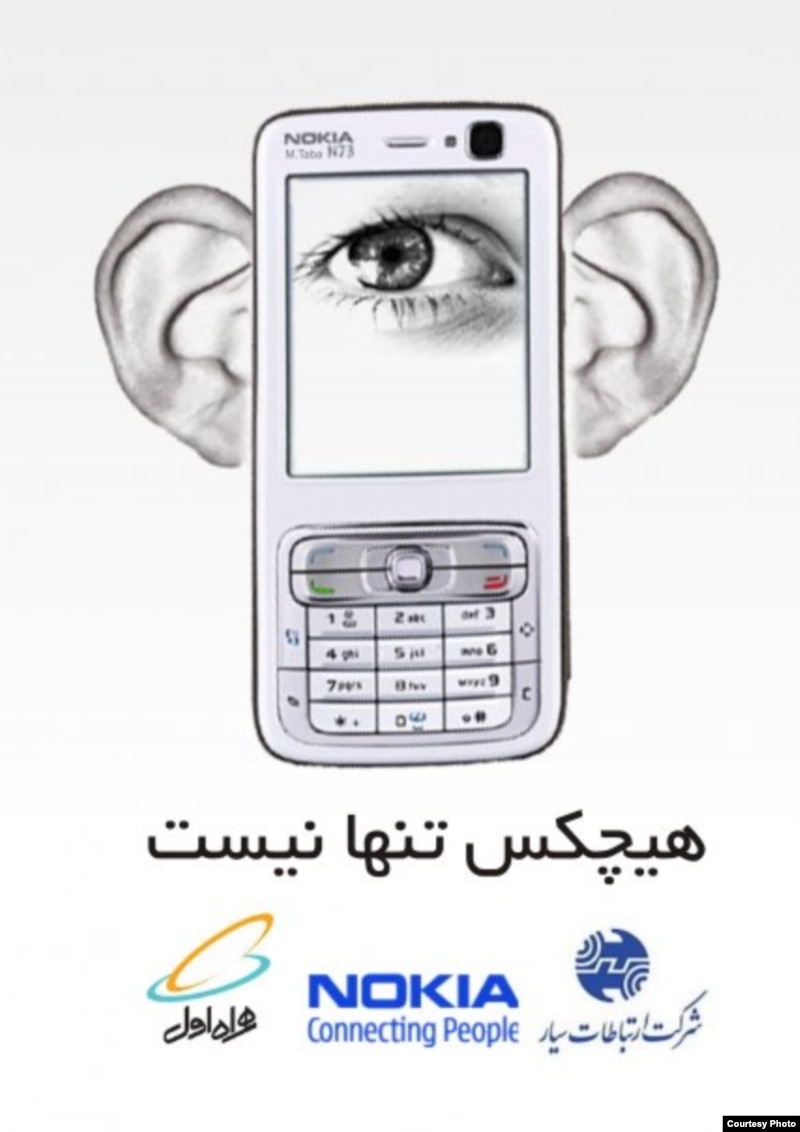
A blog titled "Boycott Nokia For Iran Crackdown" has changed Nokia's motto from "connecting people" to "jailing people." It states that Nokia has a responsibility to ensure that its technology is used in an ethical manner. On Facebook, an image is circulating showing a Nokia cell phone with ears, above text that reads: "Nobody is alone."

Nokia Siemens Networks spokesman Roome said the company carefully considers where it does business:

"We rely very heavily, as all international companies do, on international decision makers -- the governments in the countries in which we're headquartered, such as Finland and Germany; the European Union, World Trade Organization; and UN regulations -- about where we can do business," Roome said.

"So, for example we don't sell telecommunication networks to countries like North Korea or to Burma, and also we know very little and saw very little information coming out of those countries."

Going Global

The announcement of a landslide victory by incumbent President Mahmud Ahmadinejad in the June 12 election led to an outpouring of popular anger, leading the Iranian government to quickly ban all foreign media from covering the protests.

In the void of information, mobile phones played a major role in the ability of Iranian citizens to inform their fellow citizens and the outside world about the postelection protests and the brutal government response.

Iranians protesters and witnesses used their phones to film demonstrations and document beatings and shootings by the police and Basij militia forces.

The most tragic video clip recorded the death of a young Iranian woman named Neda, whose final moments were captured by a mobile phone after she was shot in the chest by a sniper. The video was quickly posted on electronic media and social networks such as YouTube and Facebook, instantly making Neda the symbol of the "green" opposition movement.

Ironically, many of the videos coming out of Iran -- some showing protests and citizens on rooftops chanting "Allah Akbar" and "Death to the dictator" under the protection of night -- are likely being filmed on Nokia cell phones.

One activist in Iran who did not want to be named says people should keep using their mobile phones to send out information about the events inside the country, while at the same time pressuring Nokia to cancel its contract with Iran.

Some, including Ehsan, say they have also stopped sending text messages from their phones altogether. Since the country's mobile network is run by the government, the reasoning goes, they hope to deny what they consider an illegal government a potential financial resource.

Sometimes the effort falls short.

Tehran-based journalist Nili says that in recent weeks he has received SMS text messages from friends advising him to stop using SMS's. 

Popular Phones With MP3 Players

Over the years of continuous improvement, the simple cellular phone can now do other functions. It is not just limited to its original role like sending a SMS message or calling someone. Some of the additional features to this device are MP3 players that can play music and video files, Camera that can take pictures or capture videos, a built in radio and some even have a built in TV. These are just some of the things that these new phones can do. The craze of mobilizing music allowing anyone to enjoy music even if she or he is on the move has also caught cellular phones.

Most of the cell phone companies now make it a point to have their new release models the capability to play MP3 ringtones. The Sony Ericson Walkman series is one proof to this. One of the best Sony Ericson Walkman models is the W890i, which aside from the ability to play WMA, WAV and MP3 files it is also just 10 mm thick and weighs about 78 grams. The phone maybe slim and slick but it can still pack a 4 Megabytes worth of music files. The advantage of the Walkman series over other Sony Ericson phones is that it can play music files with high quality audio output making it one of the best music phones out in the market. The cellular phone company Nokia also ensures that most of their new release phones can play MP3 files ringtones as well. According to some reports, the 6300 is one of the Nokia phones that can give high quality audio output making the phone the Nokia's answer to the Walkman series. Another similar phone to a Walkman phone of Sony Ericson is the Nokia's 5300, which main feature is playing MP3 and other media files. It also comes with an easy access play, pause and next button allowing the user to play an MP3 file with ease.

The Motorola cellular phone company did the same too. In almost all of its recent cell phones comes the feature allow it to play MP3 ringtones. A popular phone from Motorola is the RAZR V3, which is super slim but has a MP3 ring tone player other unique feature as well. This allows the Motorola phone users to enjoy high quality music even if he or she is on the move. The iPhone is one of the most advanced phones that can play MP3 files. It even has an interactive music player, which is what most users like.

This MP3 player feature is now a standard addition to the new phones that are released in the market today, no matter which company the phone came from. This is for the reason that cell phone users have already enjoyed the sound of a MP3 ringtone and they would not settle for anything that cannot play music.

Nokia`s new device promo starts this month

Nokia, the world phone giant is in partnership with service provider, MTN to provide exciting packages for customers who purchase their new range of handsets, the nokia 1203 and 1661 phones in it new promotion.

Starting from July 14, to august 2009, customers who buy any of these two devices from any authorized nokia outlet will also receive one MTN SIM card loaded with 50 peswas air time, two cedis bonus air time together with 10 free SMS every month.

Ngozi Ife Anane communication Manager: Nigeria and West Africa explained that the promotion was part of the groups' innovative ways of connecting people in the country.

Commenting of the high incidence of faked nokia phones on the market, she said Nokia was in partnership with relevant government institutions to clamp down on the importation of fake products into the country.

She however cautioned that Ghanaians should purchase their nokia phones from authorized outlets spotted throughout the country to ensure that they have a quality product. “We want Ghanaians to buy their phones from our authorized outlets to make sure that they have the right phone which comes with twelfth month's warranty.” She added.

This promotion also forms part nokia's ongoing efforts to bridge the digital divide by introduced a range of affordable mobile devices and innovative new services specifically for people in emerging markets. 


Nokia looks to improved software to boost U.S. business

Computerworld - When it comes to smartphone and mobile device shipments, Nokia Corp. is the nearly king of the world -- except in the U.S. Now, the Espoo, Finland-based company is in the midst of a long-term push to rectify its problems in this country.
For instance, Nokia is trying to sell more mobile phones and smartphones through U.S. carriers and is seeking ways to make its Symbian operating system software more friendly to American users, said Ira Frimere, product portfolio manager for Nokia North America.
And yesterday, Nokia introduced a new smartphone called Surge -- a move that was significant because it marked the first time the manufacturer had shipped a model without a number in its name. Analysts see that as a subtle move by the engineering-focused Scandinavian company to start using American marketing techniques. The Surge slider device, jointly developed with AT&T Inc., includes a physical QWERTY keyboard, noted Frimere.
"Our strategy is to get as many devices into U.S. carriers as possible," Frimere said in an interview. "We want to be No. 1 in the U.S."
Analysts say that reaching that goal will require some heavy lifting on the company's part, since Symbian and Nokia remain relatively unknown to most American consumers. Nokia's visibility in the U.S. stands in contrast to its status in Europe and Asia, where consumers appear to love the company's technology.
IDC recently forecast that 92 million Symbian OS-based smartphones will ship worldwide during 2009, representing 46% of the market. Those numbers make Nokia the worldwide leader in smartphone sales -- by a wide margin. But in the U.S., Symbian smartphone shipments are only projected to reach just over half a million this year, slightly more than 1% of total smartphone shipments in this country. The Nokia operating system lags far behind Research in Motion Ltd.'s BlackBerry software, as well as Windows Mobile, Mac OS X, and Palm (whose numbers now include the WebOS operating system), in the U.S.
Sean Ryan, an IDC analyst, noted that the research firm's forecasts show Symbian losing a bit of market share in coming years as Google Inc.'s Android and other new operating systems join the fray. "It really is a big difference in the way Nokia does in the U.S. compared to abroad," Ryan noted. "Mention Nokia to the average American and nobody has ever heard of it."
Frimere is one of a team of Nokia executives charged with improving the company's smartphone business in the U.S. He compared his own experience as an engineer learning marketing techniques to what Nokia is going through. "I've learned it's not what I like, but what my customer likes," he said. "A smartphone is an extension of your personality."

Nokia sees mobile phones boycotted in Iran

The mobile phone company Nokia is being boycotted in Iran because it is seen to be collaborating with the regime, it has been claimed. 

Demand for the company's products has fallen even though it is widely considered to have the best mobile phone coverage in the country.
The boycott comes after reports that the company, Nokia Siemens Networks (NSN), sold electronic surveillance systems to the Iranian government, according to The Guardian.
Vendors say they have seen sales fall by as much as half.
The newspaper claimed that the Iranian government used the mobile phone monitoring system to keep an eye on dissidents, relying on text messages and archived phone calls to use as evidence.
A spokesman for NSN told The Guardian: "As in every other country, telecoms networks in Iran require the capability to lawfully intercept voice calls.
"In the last two years, the number of mobile phone subscribers in Iran has grown from 12 million to over 53 million, so to expand the network in the second half of 2008 we were required to provide the facility to intercept voice calls on this network."
The state-run television in Iran has also been affected with companies shying away from advertising after protesters called for the economic boycott to spread across the communications industry. 


Mobilebeat2009: Nokia to shed light on OVI mess and more


The world’s largest phone maker, Nokia, will be announcing its earnings Thursday, a few hours before our mobile industry conference MobileBeat2009 kicks off.
On hand at the conference will be Nokia executive Tero Ojanpera, who I’ll be speaking with in a fireside chat. Ojanpera said the earnings release before the conference opening will give him more room to talk openly about the company’s recent progress.
He wouldn’t comment until Thursday about what the earnings will reveal, but said he hopes to clarify some misunderstandings related to the performance of Nokia’s smartphone business, as well as talk about how the OVI store is coming along
OVI is Nokia’s online store where you can download applications for your Nokia phone. It is supposed to be an answer to popular mobile app stores offered by Apple’s iPhone, Google’s Android phones and an increasing number of other players, including Vodafone and other carrier stores.
tero-ojanperaHowever, judging from the comments of several developers, the OVI store has been a disaster. Steve Boom, chief executive of Mig33, a social communication application popular on Symbian phones such as the ones Nokia sells, told me recently that his company has been frustrated because it has been unable to get Migg33 listed at the OVI store. After the store launched in May, Mig33’s logo was listed briefly at the store, but when you clicked to download, you got an error sign. Since then, Mig33’s team has continued call on Nokia’s business development representatives to point them to the error. At first, Nokia’s representatives admitted there were problems, and were responding to calls. However, the problem is still not fixed, despite months of time, and now Nokia’s representatives are simply not returning calls. There’s apparently something really, really wrong.
Ojanpera talked yesterday about the problem, he acknowledged only that the company had some server issues initially “in the early hours,” but that subsequently the company has done better and that downloads are now “surging.” He said the company is now busy taking next steps to resolve remaining issues, but that the company is now getting more positive feedback from developers — from things like billing and other services that have until now been more targeted to markets outside of the United States. At the bottom of the post are some early statistics the company is revealing about the OVI store performance.
Ojanpera also said there’s a perception that the company’s marketshare in smartphones is dropping. While market share did drop to about 38 percent in the fourth quarter of last year, from about 50 percent before, it stabilized in the first quarter, and even went up slightly. He would not comment on the second quarter performance, which will be revealed Thursday. However, he said that Nokia’s overall market share in the non-smartphone market is also about 38 percent. So the 38 percent level for smartphones appears more normal, in this light, especially considering the relative lack of competition in the smartphone marke earlier on, he said. With the arrival of a series of competitors such as the iPhone, Android phones and others, you’d expect market share to go down. The only question is, how much.
I’m sure we’ll have an in-depth conversation during the fireside chat, which opens at 8:45am on Thursday, and which will also include Palm’s executive Michael Abott, and Google’s Vic Gundotra. We’ve already written about Nokia’s embrace of QT, a platform that allows mobile developers to write in a web run-time environment. This aligns with efforts by both Google and Palm to push their own platforms that serve developers with ways to write predominantly for the Web standards instead of for more arcane proprietary operating systems and frameworks — such as Apple’s.
[By the way MobileBeat2009, our conference for mobile executives, is almost sold out. The last few tickets can be obtained here.]
Stats on OVI:
  • About 3500 content items available for the popular Nokia devices (Update: Nokia got in touch and told me this number applies only for N97, and that consumers with older device models will see much more).
  • Users from 180 countries have an active Ovi Store account
  • Top 5 downloading countries in alpha order: India, Italy, Spain, UK & US
  • Developers from 60 countries have uploaded their content to Ovi Store
  • Ovi Store is accessible from over 75 Nokia devices in 5 languages
  • Ovi Store has mobile billing from 27 operators from around the world
Content recently added:
  • Tower Bloxx Deluxe – a highly popular casual game on Facebook is now available
  • Ice Age 3 is out this month, July, and Sid is running wild across games, wallpapers and a video.
  • Lonely Planet has 23 items including city guides, videos and phrase books to make travel easier.
  • WorldMate 2009 is in the spotlight – the #1 travel app for S60 includes a currency converter, weather report & flight alerts.
Cool news apps include:
  • BandFan by Earthcomber (5800/N97) a great new touch based music app that lets you quickly & easily find where your favorite band is playing
  • kSnap & Translate – Snap a picture of any printed text & translate it in real time. Offered in Finnish, Portuguese, Swedish, Polish, French, Danish, Dutch, Italian, Norwegian, German & Spanish.
  • Pixelpipe – Connect Ovi Share to distribute photos, vid, etc to social networks, & blog services. Works with over 85 services across the Social Web.
  • EA Games added: Monopoly World, Tomb Raider Underworld, Sims 3 and more
  • New personalization content from: Lady Gaga, Beyonce, Coldplay, Pearl Jam and others
  • Nokia Messaging is available & supports thousands of leading global/local email providers
  • Guitar Hero World Tour is ready to rock your phone!
Popular Downloads:
  • “Star Trek Ringtone” is the number one downloaded item cumulative since launch
  • In June, the # 1 app in revenue was “Gravity”, developed by one person in Germany
  • In June, “Photo Twister” is #1 app in volume 

Iranian consumers boycott Nokia for 'collaboration'

The mobile phone company Nokia is being hit by a growing economic boycott in Iran as consumers sympathetic to the post-election protest movement begin targeting a string of companies deemed to be collaborating with the regime.
Wholesale vendors in the capital report that demand for Nokia handsets has fallen by as much as half in the wake of calls to boycott Nokia Siemens Networks (NSN) for selling communications monitoring systems to Iran.
There are signs that the boycott is spreading: consumers are shunning SMS messaging in protest at the perceived complicity with the regime by the state telecoms company, TCI. Iran's state-run broadcaster has been hit by a collapse in advertising as companies fear being blacklisted in a Facebook petition. There is also anecdotal evidence that people are moving money out of state banks and into private banks.
Nokia is the most prominent western company to suffer from its dealings with the Iranian authorities. Its NSN joint venture with Siemens provided Iran with a monitoring system as it expanded a mobile network last year. NSN says the technology is standard issue to dozens of countries, but protesters believe the company could have provided the network without the monitoring function.
Siemens is also accused of providing Iran with an internet filtering system called Webwasher.
"Iranians' first choice has been Nokia cellphones for several years, partly because Nokia has installed the facility in the country. But in the past weeks, customers' priority has changed," said Reza, a mobile phone seller in Tehran's Big Bazaar.
"Since the news spread that NSN had sold electronic surveillance systems to the Iranian government, people have decided to buy other company's products although they know that Nokia cellphones function better with network coverage in Iran."
Some Tehran shops have removed Nokia phones from their window displays. Hashem, another mobile phone vendor, said: "I don't like to lose my customers and now people don't feel happy seeing Nokia's products. We even had customers who wanted to refund their new Nokia cellphones or change them with just another cellphone from any other companies.
"It's not just a limited case to my shop – I'm also a wholesaler to small shops in provincial markets, and I can say that there is half the demand for Nokia's product these days in comparison with just one month ago, and it's really unprecedented. People feel ashamed of having Nokia cellphones," he added.
News of the boycott has appeared on the front page of Iranian pro-reform papers such as Etemad-e Melli, owned by the reformist candidate Mehdi Karroubi. Hadi Heidari, a prominent Iranian cartoonist, has published an image of a Nokia phone on a No Entry traffic sign.
A Nokia spokeswoman refused to comment on the company's sales in Iran.
The Iranian authorities are believed to have used Nokia's mobile phone monitoring system to target dissidents. Released prisoners have revealed that the authorities were keeping them in custody on the basis of their SMS and phone calls archive, which was at officials' disposal.
One Iranian journalist who has just been released from detention said: "I always had this impression that monitoring calls is just a rumour for threatening us from continuing our job properly, but the nightmare became real when they had my phone calls – conversations in my case.
"And the most unbelievable thing for me is that Nokia sold this system to our government. It would be a reasonable excuse for Nokia if they had sold the monitoring technology to a democratic country for controlling child abuse or other uses, but selling it to the Iranian government with a very clear background of human rights violence and suppression of dissent, it's just inexcusable for me. I'd like to tell Nokia that I'm tortured because they had sold this damn technology to our government."
NSN spokesman Ben Roome said: "As in every other country, telecoms networks in Iran require the capability to lawfully intercept voice calls. In the last two years, the number of mobile subscribers in Iran has grown from 12 million to over 53 million, so to expand the network in the second half of 2008 we were required to provide the facility to intercept voice calls on this network."
In other sectors, state-run TV has also been targeted by protesters who have listed products advertised on its channels and urged supporters to join a boycott. Companies are running scared, and viewers have noticed the number of commercials plummet.
"We don't have many choices to show and continue our protests. They don't let us go out, they have killed many, we are threatened to text people or distribute emails, they have summoned people who shout Allahu Akbar ['God is great'] on rooftops at nights, so we need to look for new ways," said Shahla, a 26-year-old Iranian student.
"I can obviously see on the TV that they are facing an [advertising] crisis. This at least shows them how angry people are," she added.
The SMS boycott, meanwhile, has apparently forced TCI into drastic price hikes. The cost of an SMS has doubled in recent days. Protesters view the move as a victory.